Midleton and Ladysbridge
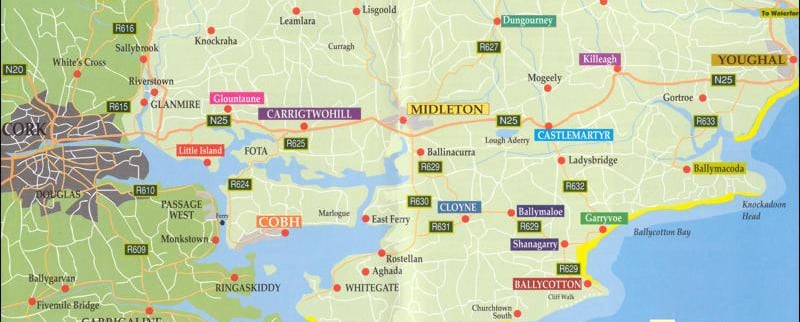
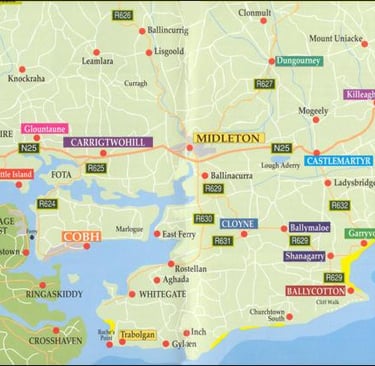
This map helps place Midleton and Ladysbridge within the wider East Cork landscape. These places are useful for understanding family movement between townlands, churches, markets, civil records, roads, coastal communities, and nearby parish-register areas.
Civil, Parish, and Movement Context in East Cork
Midleton and Ladysbridge are important for understanding how the Dorgan family’s records fit into the wider East Cork civil and parish landscape.
Midleton frequently appears as a registration, market-town, and service center for families living in surrounding rural townlands. Ladysbridge is important because of its close association with the Ballymacoda / Ladysbridge Catholic parish registers in which several children of Patrick Dargan / Dorgan and Johanna / Anne / Nancy Flynn were baptized.
Together, the two places help explain why one family may appear under Carrigkilter, Ballybraher, Ballymacoda, Ladysbridge, Cloyne, Churchtown, or Midleton depending on the type of record being consulted.
Why Midleton Matters
Midleton is especially important as a civil-registration and administrative reference point rather than as the ancestral home of the Carrigkilter Dorgan family.
Births, marriages, and deaths from surrounding East Cork communities may be indexed or registered under Midleton even when the people themselves lived in Carrigkilter, Ballybraher, Cloyne, Garryvoe, Churchtown South, or another nearby locality.
This distinction is important when interpreting civil records: the registration district is not necessarily the person’s residence.
Midleton also served as a regional market and service town and therefore forms part of the practical landscape through which nearby families moved.
Why Ladysbridge Matters
Ladysbridge is directly important to the family because the Ballymacoda / Ladysbridge Catholic registers preserve the early baptismal sequence of Patrick Dargan / Dorgan and Johanna Flynn’s children.
Daniel, Mary, Elizabeth, Timothy, and David were baptized within this parish-register context between 1838 and 1846. Those records belong to the same documented family that later appears in the Carrigkilter land evidence beginning in 1847.
The detailed baptismal evidence, including sponsors and name variations, is preserved on the Ballymacoda and Children of Patrick Dargan / Dorgan and Johanna Flynn pages rather than repeated here.
Mary Dorgan and the Midleton Civil Context
Mary Dorgan’s 10 July 1866 marriage to Jeremiah Healy provides a useful example of how several East Cork place systems overlap.
Mary was residing at Ballybraher. The Catholic marriage took place at the RC Chapel of Churchtown, while the civil record belongs to the Aghada registrar’s district within the Midleton Union.
One marriage therefore connects Ballybraher, Churchtown, Aghada, and Midleton without implying that Mary actually lived in all four places.
This is exactly why Midleton is important to the archive: it helps interpret civil-registration geography correctly.
David D. Dorgan and Elizabeth Ahern / Ahearne
David D. Dorgan’s 1881 marriage to Elizabeth / Eliza Ahern / Ahearne provides another important connection between the Carrigkilter family, Ballybraher, and the wider Midleton-area civil-record system.
Their marriage belongs to the later generation of Patrick and Johanna’s family and illustrates how nearby farms, parish records, civil districts, and neighboring families overlap in East Cork research. The current page already identifies this marriage as part of the Midleton registration context.
Midleton and the 1897 Emigration
Midleton also appears in the family’s migration story.
When Mary Catherine Hartnett Dorgan traveled to America with the children aboard the Teutonic in June 1897, the passenger manifest recorded their last residence as Midleton.
This does not mean the family’s earlier Carrigkilter history should be reassigned to Midleton. Rather, it provides an important final East Cork locality associated with the family immediately before emigration.
How the Places Fit Together
The documentary pattern can be summarized simply:
Carrigkilter — principal landholding anchor for Patrick Dargan / Dorgan.
Ballymacoda / Ladysbridge — principal early baptismal-register context.
Ballybraher — documented residence of Mary Dorgan in 1866 and later Ahern / Ahearne connections.
Churchtown South — location of Mary Dorgan’s 1866 Catholic marriage.
Cloyne — important marriage and later family center.
Midleton — civil-registration, market-town, and later movement context.
These places should therefore be connected through the records without treating their names as interchangeable residences.
Research Conclusion
Midleton and Ladysbridge are important not because they replace Carrigkilter as the family’s geographic anchor, but because they explain how the family appears across parish, civil, marriage, migration, and regional records.
Ladysbridge helps preserve the earliest documented child sequence. Midleton helps interpret the civil and administrative framework surrounding later East Cork records.
Related Pages
Ballymacoda
The detailed baptismal-register page for Daniel, Mary, Elizabeth, Timothy, and David Dorgan.
Children of Patrick Dargan / Dorgan and Johanna Flynn
The complete documented child sequence and later family evidence.
Carrigkilter Research Hub
The principal land and family research center for Patrick Dargan / Dorgan.
Ballybraher
Mary Dorgan’s 1866 residence and the later Ahern / Ahearne family connection.
Churchtown South and Ballycatoo
The parish and geographical context for Mary Dorgan’s 1866 marriage.
Cloyne: Parish and Market-Town Reference Point
The later marriage, Rock Street, and Cloyne branch evidence.
The Journey from East Cork to Rhode Island
The emigration story connecting the family’s Irish records with Rhode Island.
Records Archive
Original civil, parish, land, census, emigration, and related records.