Ballycotton and Garryvoe
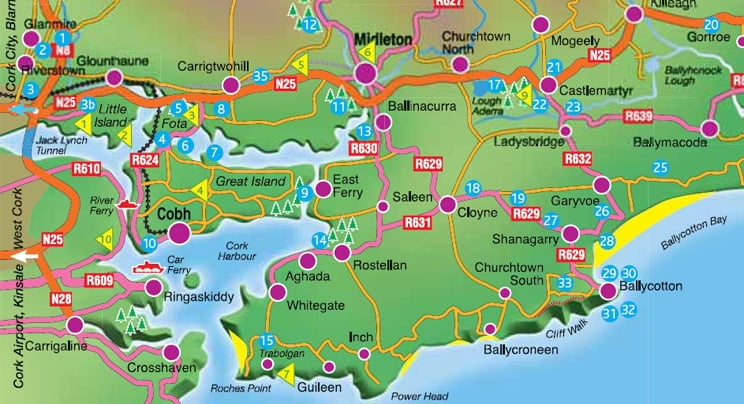
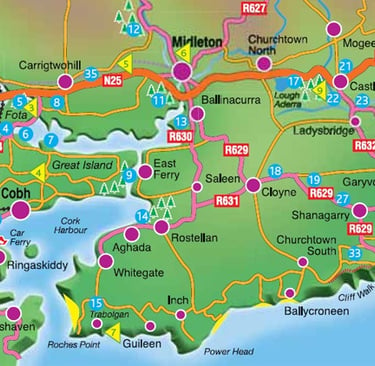
This map shows the coastal East Cork setting around Ballycotton and Garryvoe, including nearby places such as Cloyne, Ladysbridge, Ballymacoda, Shanagarry, Churchtown South, Midleton, and Aghada. These locations help explain how Dorgan, Dargan, Flynn, Hartnett, Healy, Barry, Cashman, Motherway, and related family records may connect across parish registers, land records, maps, roads, and neighboring townlands.
Coastal East Cork Context
Ballycotton and Garryvoe form an important part of the coastal East Cork landscape surrounding the documented Dargan / Dorgan family. Their significance comes from two different research directions: Ballycotton and nearby Ballyandreen are important to the unresolved Flynn ancestry, while Garryvoe contains nineteenth-century Dorgan land evidence that may help identify relatives of Patrick Dargan / Dorgan of Carrigkilter.
These places should be studied alongside Aghada, Cloyne, Ballymacoda, Ladysbridge, Carrigkilter, and Ballybraher. The records overlap geographically, but evidence from these coastal locations should not automatically be merged with the proven Carrigkilter family.
Ballycotton, Ballyandreen, and the Flynn Question
Ballycotton is particularly important to the maternal side of the research because family tradition associates Johanna Flynn’s family with the Ballyandreen area.
A baptism recorded on 17 November 1817 names a Johanna Flynn as the daughter of Michael Flynn and Anne Barry, with William Kirby and Johanna Gorman as sponsors. This record is an important candidate for the later wife of Patrick Dargan / Dorgan, but it has not been proved to be the same woman.
The Ballyandreen tradition and the Flynn, Barry, Kirby, and Gorman names make the record worth continued investigation. Ballycotton, Ballyandreen, and Aghada should therefore be compared carefully with the later Carrigkilter family records, baptismal sponsors, witnesses, cemetery evidence, and neighboring Flynn households.
For now, the 1817 baptism remains a candidate, not Johanna Flynn Dorgan’s confirmed baptism.
Garryvoe and the Dorgan Land Evidence
Garryvoe has become one of the most important locations in the search for Patrick Dargan / Dorgan’s earlier family because Daniel Dorgan / Dargan is now documented there through a continuous series of land, parish, marriage, and civil records.
In the 1847 Valuation Office records, Daniel Dorgan occupied Garryvoe Upper lot 5 from Edward Hoare, Esq. His holding consisted of a house, offices, and approximately 20 acres of land. The valuation clerk also explicitly cross-referenced Daniel to a holding in Garryvoe Lower.
The published 1853 Griffith’s Valuation confirms the continuation of Daniel’s principal Upper Garryvoe holding. At map reference 5a, Daniel Dargan held a house, offices, and 20 acres, 0 roods, 37 perches of land from Edward Hoare. Daniel also acted as immediate lessor within the same holding. A National school-house was held under him at map reference 5b, and Michael Dargan occupied a house and garden under Daniel at map reference 5c.
Daniel also appears in Garryvoe Lower in Griffith’s Valuation. At map reference 13 he held land from Edward Hoare, while at map reference 14 he held land from Garrett and Roger Motherway.
The Motherway connection is especially significant. Garrett and Roger Motherway appeared near Daniel in the earlier Garryvoe Upper valuation records. Daniel Dorgan and Mary Motherway later served together as baptismal sponsors in 1851, and Garrett and Roger Motherway were Daniel’s immediate lessors in Garryvoe Lower in 1853.
Daniel married Margaret Boozane on 14 February 1848 in the Roman Catholic parish of Ballymacoda and Ladysbridge. The original parish register names Pat Boozane and Thomas Higgins as witnesses.
Margaret Boozane / Beausang
Daniel's wife, Margaret, belonged to the local Boozane / Beausang family. Their original 14 February 1848 Ballymacoda and Ladysbridge marriage entry records her as Margaret Boozane and names Pat Boozane and Thomas Higgins as witnesses.
Family evidence from Margaret's direct descendant Una Niche indicates that Boozane, Beausang, and related spellings were used interchangeably in Irish records, depending upon the priest or clerk making the entry. The archive therefore treats these forms as surname variants while preserving the spelling found in each original record.
The Boozane / Beausang connection may also help explain repeated appearances of the family within the baptismal network surrounding Daniel Dorgan in the Ballymacoda, Ladysbridge, Kilcredan, and Garryvoe area.
Daniel died at Garryvoe on 30 December 1893, aged 83. His civil death registration describes him as a widowed farmer and names Daniel Lee, his son-in-law, as the informant.
The combined evidence strongly supports identifying the Daniel who married Margaret Boozane and died at Garryvoe with the Daniel Dorgan / Dargan documented in both Garryvoe Upper and Garryvoe Lower.
An older adult Daniel Dorgan also served as sponsor at Mary Dorgan’s 1840 baptism. Because Patrick and Johanna’s son Daniel had been baptized only in 1838, the sponsor was necessarily an older man. The Garryvoe Daniel is now a strong candidate for that 1840 sponsor and may have been a brother or other close relative of Patrick Dargan / Dorgan of Carrigkilter.
The precise relationship between Daniel and Patrick has not yet been proved and should remain an open research question.John Dorgan of Garryvoe Lower
Mary Dorgan and Daniel Lee of Garryvoe Upper
Mary Dorgan, daughter of Daniel Dorgan and Margaret Boozane/Beausang, was baptized on 23 November 1860 in Ballymacoda and Ladysbridge parish.
She later married Daniel Lee and lived at Garryvoe Upper. Their relationship provides important evidence for reconstructing the Garryvoe Dorgan family. When Daniel Dorgan died in 1893, Daniel Lee registered the death and was identified as Daniel's son-in-law.
The 1901 Census provides an additional and particularly strong link. Daniel Lee was head of the household at Garryvoe Upper, Mary was recorded as his wife, and the household also included 77-year-old Margaret Dorgan, identified explicitly as Daniel Lee's mother-in-law.
Taken together with Mary's baptism naming Daniel Dorgan and Margaret Boozane as her parents, these records establish Mary Dorgan as the daughter of Daniel and Margaret who married Daniel Lee.
The census gives Mary an age of 37 in 1901, several years younger than indicated by her 1860 baptism. The baptismal date is the stronger evidence for her early life.
John Dorgan at Garryvoe Lower
Griffith’s Valuation also records John Dorgan at Garryvoe Lower. This establishes another Dorgan household in the coastal East Cork area.
John should remain a comparison-family candidate. He has not been proved to be Patrick Dargan / Dorgan’s brother, and he should not automatically be identified with the John Dorgan baptized in 1839 to Edmond Dorgan and Mary Cusack of the Kilmacahill family.
Chronology, residence, landholding, marriage, and later records must be compared before assigning an identity or relationship.
What the Coastal Evidence May Tell Us
The Ballycotton and Garryvoe evidence approaches the Carrigkilter family from two sides.
On the Flynn side, Ballyandreen and the 1817 Johanna Flynn baptism provide a possible route toward identifying Johanna’s parents.
On the Dorgan side, Daniel Dorgan / Dargan of Garryvoe is now documented as a substantial landholder in both Garryvoe Upper and Garryvoe Lower and as part of a repeated Dorgan–Motherway–Boozane parish and land network. He is one of the strongest candidates for a close relative of Patrick Dargan / Dorgan of Carrigkilter.
Neither connection is proved. Their importance lies in giving the research specific people, places, and records to test rather than relying only on surname similarity or geographical proximity.
Research Conclusion
Confirmed: Confirmed: Daniel Dorgan / Dargan was a Garryvoe farmer documented in both Garryvoe Upper and Garryvoe Lower. His 1847 and 1853 land records establish continuity of his principal Upper Garryvoe holding and document his relationships with Michael Dargan and the Motherway family.
Important candidate evidence: the 1817 Johanna Flynn baptism and Ballyandreen tradition may relate to Johanna Flynn Dorgan.
Strong candidate evidence: Daniel is a strong candidate for the older Daniel Dorgan who sponsored Mary Dorgan in 1840.
Not proved: Daniel’s precise relationship to Patrick Dargan / Dorgan of Carrigkilter; John Dorgan’s relationship to Patrick; and the identification of the 1817 Johanna Flynn as Patrick’s wife.
This keeps Ballycotton and Garryvoe central to the research without turning promising clues into established genealogy.
Related Pages
Garryvoe Lower
The focused land-record page for John Dorgan, Garryvoe Lower holdings, maps, and comparison evidence.
Early Dorgans in East Cork
The main comparison page for Daniel, John, Edmond, and other early Dargan / Dorgan evidence.
Johanna / Anne Flynn Dorgan of East Cork
The detailed page for Johanna’s documented family, possible 1817 baptism, Ballyandreen tradition, and unresolved parentage.
Aghada
Parish-register and Flynn-family context for the possible Johanna Flynn baptism and Ballyandreen evidence.
Patrick Dargan / Dorgan of Carrigkilter
The documented Carrigkilter family line and unresolved search for Patrick’s parents.
Carrigkilter Research Hub
The central page for land, parish, map, sponsor, and family evidence.
Ballymacoda
The confirmed baptism sequence and sponsor evidence for Patrick and Johanna’s children.
Records Archive
Original parish, valuation, map, cemetery, civil, and related family records.